
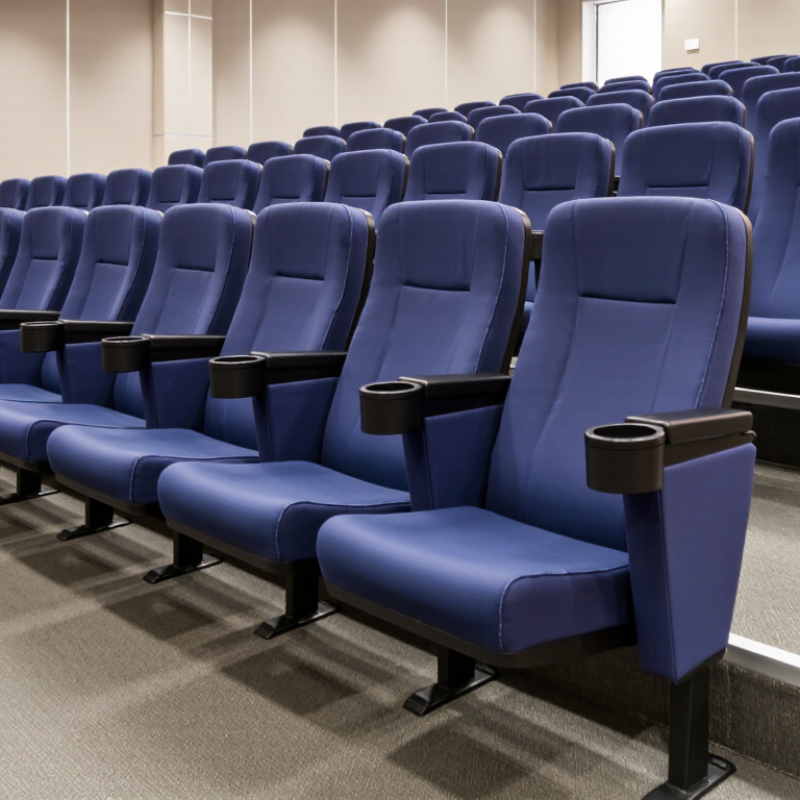
China’s auditorium chairs for sale market is expanding with new cinemas, conference venues, universities, and cultural centers. Buyers now expect more than attractive upholstery and competitive pricing.
The Grand View Research seating industry reports identify durability, ergonomic design, and venue expansion as major purchasing factors. Research and Markets’ Auditorium Seating Global Market Report also highlights replacement demand and commercial construction as important growth drivers. These findings matter when comparing Chinese manufacturers, because a low quotation may hide weaker foam, thinner steel, or limited after-sales support.
Comfort comes first.
According to seating consultant David Rowland, “A successful auditorium chair supports attention without becoming the audience’s main distraction.” That principle is practical. A well-designed chair should open smoothly, return quietly, and preserve clear aisle access. Its armrests should feel stable after repeated use. Its fabric should resist stains from coffee, raincoats, and thousands of visitors.
For buyers searching auditorium chairs for sale, supplier verification remains essential. Request load testing, fire-performance documentation, warranty terms, and installation references. Check whether the factory controls welding, powder coating, foam cutting, and upholstery internally. ISO certification can support credibility, but it does not automatically prove long-term comfort.
This guide will examine Chinese auditorium chair suppliers, wholesale pricing, materials, customization, shipping, and project support. It will also question common assumptions. The cheapest chair may not be the best value. A premium model may still fail if installation is careless. Real performance depends on the complete seating system, not one impressive product photograph.
China Top Auditorium Chairs for Sale Wholesale?
Choosing auditorium seating from China requires more than comparing unit prices. Fixed chairs suit permanent halls, lecture rooms, and cinemas with stable layouts. They usually provide stronger row alignment and fewer moving parts. Retractable seating slides or folds into compact storage, helping multipurpose venues change from conferences to exhibitions. Tip-up seats save aisle space when unused. They also improve circulation, but hinges and counterweights need careful inspection.
Space efficiency has measurable value. The 2023 Global Status Report for Buildings and Construction states that buildings consume about 34% of global energy and produce roughly 37% of energy-related emissions. Retractable seating can support better room utilization, although it does not automatically reduce operating costs. A project team should check floor loading, storage depth, row spacing, fire routes, and cleaning access before placing a wholesale order. I have seen attractive layouts fail during maintenance reviews.
Accessibility must remain practical. The U.S. Access Board’s ADA Standards specify a minimum wheelchair space of 30 by 48 inches, with additional maneuvering considerations. Local regulations may require more. Ask suppliers for load tests, cycle testing, flame-resistance documents, dimensional drawings, and material samples. Tip-up mechanisms should move smoothly, without sudden impact or exposed pinch points. Cheap hardware is not always cheap later. A seating mock-up is worthwhile. It may reveal uncomfortable knee clearance, poor sightlines, or noisy movement before hundreds of chairs arrive.
China Top Auditorium Chairs for Sale Wholesale?
For wholesale auditorium projects, seat width and row pitch deserve careful checking before price comparisons. A 500–600 mm seat width gives users different comfort levels, especially with shared armrests. In practice, 540 mm often feels balanced for public halls. Wider seats improve comfort but reduce the number of seats per row. That trade-off matters.
Row pitch should normally stay between 850 and 1100 mm. An 850 mm pitch supports compact layouts, while 950–1100 mm allows easier passage and safer movement. Measure from one seat reference point to the same point behind it. Do not measure only the visible cushion. Backrest thickness, reclining movement, and aisle access can change the usable distance. Small errors become expensive.
I recommend testing a full sample row before placing a large wholesale order. Walk through it with winter clothing, open a notebook, and check knee clearance. Confirm seat width after upholstery, not only from technical drawings. Materials, foam recovery, anchoring, and folding noise also deserve inspection. I once underestimated rear leg clearance on a tight layout. The drawing looked correct, but the installed row felt crowded. That mistake was avoidable. Project teams should also verify local fire, accessibility, and installation requirements with qualified professionals. Specification sheets are useful. They are not the whole experience.
China Top Auditorium Chairs for Sale Wholesale?
Wholesale auditorium seating should be judged by test evidence, not attractive photographs. ISO 7173 evaluates seating strength and durability under repeated loads. It helps buyers examine frames, joints, seat pans, and backrests. Ask for the exact tested model and configuration. A report for one chair may not cover another design. That detail is easy to miss.
EN 12727 applies to ranked seating, including fixed rows used in auditoriums and lecture halls. It examines strength, durability, and connection performance. Check test loads, cycle counts, seat spacing, and anchoring conditions. Installation matters greatly. A strong chair can perform poorly when the floor fixing is weak or incorrectly positioned. Request drawings, material specifications, and installation instructions before approving a wholesale order.
NFPA 260 focuses on the ignition resistance of upholstered furniture components. It can assess fabric, foam, and covering combinations under specified flame exposure. The result depends on the complete tested assembly, not fabric alone. Ask whether the supplied foam and upholstery match the report. Real projects are less tidy. Different batches may vary slightly. That deserves review. I would also inspect sample chairs, hardware, edge finishing, and folding mechanisms before shipment. These checks cannot replace laboratory testing, but they reveal practical weaknesses early. A careful purchasing file should record report numbers, laboratory details, production tolerances, and inspection findings. Partial evidence is still partial evidence.
This chart compares the primary scope of three recognized test standards. A value of 1 indicates that the standard directly addresses the listed quality area; 0 indicates that the area is outside its primary testing scope. ISO 7173 focuses on seating strength and durability, EN 12727 covers fixed seating subjected to severe-use testing, and NFPA 260 evaluates the resistance of upholstered furniture components to ignition by smoldering cigarettes.
China Top Auditorium Chairs for Sale Wholesale?
Selecting Chinese auditorium chairs for wholesale requires more than comparing online prices. A capable supplier should state the MOQ clearly, including whether it applies per color, fabric, or model. Some factories accept 100 units, while others require 300 or more. Ask for a written quotation with tooling, packaging, and replacement-part costs included. Hidden fees can damage an otherwise attractive offer.
A realistic production lead time is usually 20–40 days after deposit and design approval. Confirm the timeline for fabric selection, sample approval, production, and inspection. Request measurable QC records, not general promises. Useful indicators include an AQL inspection level, seat load testing, folding-cycle results, welding checks, foam density, and carton drop-test performance. For example, inspectors can record frame defects by batch and photograph finished rows before shipment. Sample testing matters.
Tips: Order a pre-production sample. Check seat alignment, noise, fabric tension, and fixing holes. Count every accessory. A simple checklist prevents expensive confusion. However, no QC plan is perfect; small color differences may still appear between fabric batches. Discuss acceptable tolerances before production, and keep signed samples for comparison. Experienced buyers also reserve several days for inspection and corrections, rather than trusting the supplier’s estimated shipping date.
Comparative evaluation framework for wholesale auditorium chair suppliers, using anonymized supplier profiles and practical procurement metrics.
| Supplier Profile | Typical Product Scope | MOQ per Model / Color | Standard Lead Time | Frame Material | Seat & Back Upholstery | Load-Test Requirement | Dimensional Tolerance | Pre-Shipment Defect Rate | QC Documentation | Evaluation Result |
|---|---|---|---|---|---|---|---|---|---|---|
| Tier A | Fixed auditorium chairs with upholstered seat and back, writing tablet optional | 100 units | 25–35 days | Powder-coated cold-rolled steel frame | Fire-retardant fabric; molded foam seat cushion | Static seat load: 1,136 N minimum | ±2 mm for major structural dimensions | ≤1.5% | Incoming, in-process, final inspection and carton checklist | Preferred |
| Tier A | Retractable telescopic seating with automatic seat return | 80 units | 30–40 days | Reinforced steel structure with corrosion-resistant coating | High-density foam with replaceable upholstery panels | Seat mechanism cycle test: 10,000 cycles | ±2 mm for seat alignment | ≤2.0% | Mechanism-cycle report, packing inspection and final AQL report | Preferred |
| Tier B | Standard fixed seating for cinemas, lecture halls and training rooms | 150 units | 25–35 days | Welded steel side supports and beam-mounted frame | Polyester fabric; molded polyurethane foam | Static seat load: 1,000–1,136 N | ±3 mm for seat and armrest position | ≤3.0% | Final visual inspection and random carton inspection | Acceptable |
| Tier B | Auditorium chairs with cup holder, aisle-end panel and numbered seat plate | 200 units | 30–40 days | Powder-coated steel with molded plastic trim | Fabric or synthetic leather upholstery | Armrest load: 750 N; seat load: 1,000 N | ±3 mm for visible components | ≤3.5% | Material checklist and pre-shipment photographs | Review Carefully |
| Tier B | Budget lecture-hall seating with foldable seat and fixed armrests | 300 units | 20–30 days | Standard welded steel frame | Basic fabric and medium-density foam | Static seat load: 800–1,000 N | ±4 mm for non-critical trim | ≤4.0% | Visual inspection and quantity verification | Cost-Oriented |
| Tier C | Entry-level fixed chairs with limited upholstery and finish options | 500 units | 20–30 days | Painted steel frame | Standard fabric; fixed foam specification | Static seat load declared by supplier | ±5 mm unless otherwise specified | ≤6.0% | Basic quantity and appearance inspection | Higher Risk |
| Tier A | Premium seating with acoustic back panel and removable seat cushion | 100 units | 35–40 days | Reinforced steel frame with durable powder coating | Fire-retardant textile or synthetic leather; high-density foam | Seat and back durability test plus 10,000 folding cycles | ±2 mm for frame and upholstery alignment | ≤1.5% | Pre-production sample approval, process records and final AQL report | Preferred |
| Tier C | Mixed-container supply with multiple standard chair configurations | 50 units per configuration | 35–45 days | Steel frame; coating specification varies by model | Fabric, vinyl or leather-look materials subject to availability | Supplier-declared load test; independent report recommended | ±4–5 mm depending on configuration | ≤5.0% | Sample approval and loading photographs; limited process records | Verify Before Order |
When comparing China auditorium chairs for wholesale, start with the real FOB cost, not only the quoted unit price. FOB usually covers chair production and delivery to the export port. Ocean freight, insurance, import duties, unloading, and local delivery remain separate expenses. Ask for a written packing list and a complete FOB quotation.
Container capacity depends on packed volume, chair structure, and carton protection. A typical packed chair may occupy 0.10–0.14 cubic meters. A 40-foot high-cube container often carries about 55–65 usable cubic meters. That range is not guaranteed. Armrests, writing tablets, and stronger packaging can reduce capacity. For example, 300 chairs at 0.12 cubic meters require about 36 cubic meters. Confirm the calculation with the factory before payment.
Spares deserve careful planning. Order 5–10% extra chairs, or at least several replacement parts for long-term projects. A 300-seat auditorium may need 15–30 spare chairs. At an FOB price of 52 dollars, 324 chairs cost 16,848 dollars before shipping and destination charges. This figure feels simple, but it can mislead if spare cartons change the container size. Request loading photos, carton dimensions, gross weight, and a final commercial invoice. I have seen buyers save on unit price, then pay more for unused container space. The cheaper quote was not cheaper.