
Choosing the best Decorative Boards supplier in China is not just a price comparison. Global buyers need to assess surface consistency, core construction, emissions data, and export experience. A sample can look flawless under a showroom lamp, then reveal color variation beside a window. Ask for current technical sheets, batch details, and samples from the production range—not only a polished display piece. Small checks matter.
As sourcing specialist Grace Liu puts it, “A reliable board is judged by its surface, its core, and the evidence behind both.” Treat that as a practical buying principle, not a substitute for independent verification. Confirm whether the supplier manufactures the boards or coordinates production, and clarify who handles quality checks before shipment. Also compare lead times, packaging, and how the supplier manages claims. These details can matter as much as a low quotation.
This guide outlines how to shortlist Chinese suppliers, compare product specifications, and reduce avoidable sourcing surprises. It considers common options such as melamine-faced boards, decorative laminates, and veneer finishes, while recognizing that requirements differ by project. No checklist removes every risk. Buyers should test samples against their own lighting, installation conditions, and performance needs. A careful process takes time, and sometimes the best choice is not the cheapest one.
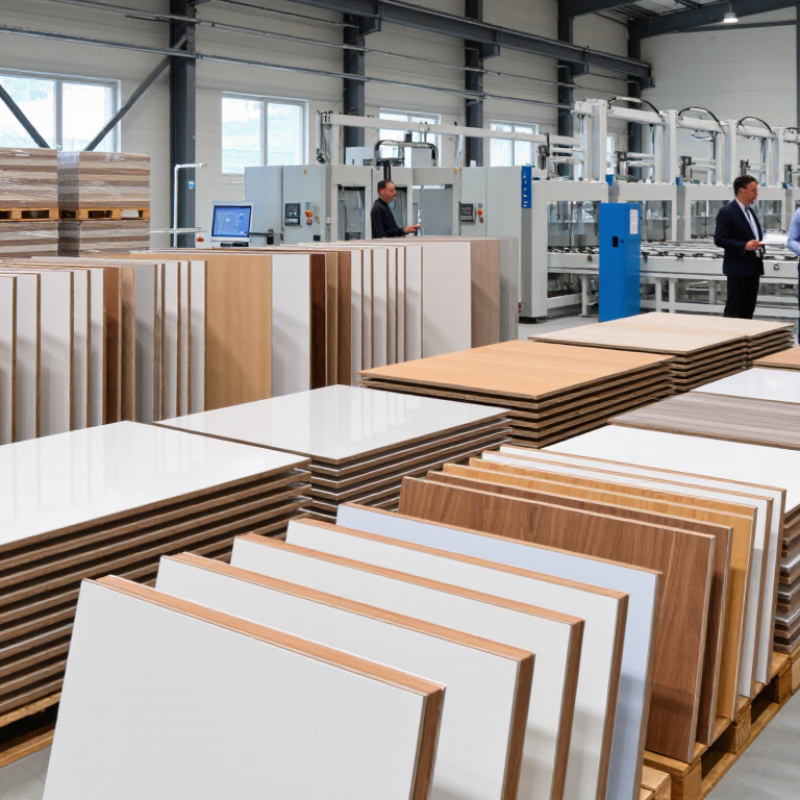
Decorative boards are panels with finished surfaces that add color, texture, or pattern to interiors. Their cores may be made from MDF, particleboard, plywood, or solid wood. Common finishes include wood veneer, laminate, melamine, and paint. You’ll find them in kitchen cabinets, wardrobes, desks, wall panels, and retail displays. A pale oak-effect board can brighten a small room, while a textured dark surface may suit a reception counter. The look matters, but so does the panel beneath it.
In practical specification, match the board to its location and daily use. Kitchen doors face frequent handling, while bathroom cabinetry may encounter moisture and need suitable materials and sealed edges. Check thickness, surface durability, cleaning guidance, and whether cut edges require finishing. That distinction matters. There is no perfect finish for every room, and even a convincing wood pattern may look repetitive across a large surface. Reviewing a sample in the actual lighting can reveal details photographs miss.
Tips: Compare samples beside flooring and wall colors. Ask how exposed edges should be treated. Confirm care instructions before installation, and leave room for sensible ventilation where moisture is a concern.
China offers several decorative-board types, each suited to different uses. Plywood uses bonded veneer layers and works well for cabinets and curved components. Medium-density fibreboard has a smooth face for painted or routed details. Particleboard is often used in furniture interiors, while oriented strand board has a visible strand texture for utilitarian designs.
FAO’s Global Forest Products Facts and Figures 2022 reports roughly 215 million cubic metres of wood-based panel production in China that year. This figure covers panel categories broadly; it does not measure decorative-grade output alone. Scale matters, but it cannot confirm a board’s consistency. Check thickness tolerance, surface finish, core density, and test documentation against the project specification.
Veneered and melamine-faced boards are also common choices. These describe surface treatments, not separate core materials: either may be applied to suitable MDF or particleboard. A sample can look convincing under showroom lights. Inspect it in natural light, check edge banding, and compare samples from different batches. There is a catch: attractive faces can hide uneven cores or weak bonding, so request relevant test results and confirm the stated substrate before ordering.
Best Decorative Boards Supplier in China for Global Buyers? - Main Types of Decorative Boards Available in China
| Board Type | Typical Core or Base Material | Common Decorative Surface | Typical Thickness Range | Common Applications | Buyer Considerations |
|---|---|---|---|---|---|
| Melamine-Faced Particleboard | Particleboard made from wood particles and resin binder | Melamine-impregnated decorative paper; plain, wood-grain, or patterned designs | About 9–25 mm | Cabinet carcasses, wardrobes, shelving, office furniture, and interior fit-outs | Confirm panel thickness, emission class, surface texture, edge quality, and whether the board is suitable for the intended humidity conditions. |
| Melamine-Faced MDF | Medium-density fiberboard made from refined wood fibers and resin binder | Melamine paper in solid colors, wood patterns, or other printed designs | About 3–25 mm | Furniture doors, drawer fronts, shelving, wall panels, and interior joinery | Check thickness tolerance, flatness, surface finish, machining requirements, and the specified formaldehyde-emission standard. |
| Decorative Plywood | Cross-laminated wood veneers bonded in layers | Natural wood veneer, dyed veneer, printed paper, or laminate surfaces | About 3–30 mm | Furniture, cabinetry, wall paneling, partitions, and applications where a plywood core is preferred | Ask about veneer species and thickness, core construction, face and back grades, bonding class, and applicable test documentation. |
| HPL-Faced Board | Usually MDF, particleboard, or plywood, faced with high-pressure laminate | High-pressure laminate in solid colors, patterns, or textured finishes | About 6–30 mm overall; depends on the substrate and laminate | Countertops, work surfaces, furniture panels, wall cladding, and commercial interiors | Specify the laminate grade and thickness, substrate, edge treatment, intended use, and any required resistance or fire-performance tests. |
| Veneer-Faced MDF | Medium-density fiberboard with a wood-veneer face | Natural or reconstituted wood veneer, often with a clear or tinted coating | About 6–25 mm | Furniture, decorative wall panels, cabinet doors, and interior architectural details | Confirm veneer species, matching method, face grade, coating system, and whether the back is balanced to help reduce warping. |
| Decorative Cement Board | Cement-based board reinforced with fibers or other reinforcing materials | Paint, textured coating, printed finish, or a separately applied decorative surface | About 4–20 mm | Wall linings, wet-area substrates, soffits, and selected interior or exterior applications | Check intended exposure, density, edge profile, fixing method, and compliance with local building and fire requirements. |
| Decorative PVC Foam Board | Rigid foamed polyvinyl chloride (PVC) | Printed, coated, or laminated surface; may also be supplied in solid colors | About 3–30 mm | Signage, display panels, cabinetry components, and selected lightweight interior applications | Request density, dimensional tolerance, surface compatibility, and relevant fire or chemical-resistance information for the end use. |
When evaluating Chinese decorative board suppliers, look beyond a polished catalogue. Ask for a current technical sheet listing core material, thickness tolerance, surface finish, moisture resistance, and relevant emissions test results. Request samples from the production line, not only showroom pieces. Check edges, corners, and the back under ordinary light. A smooth face can hide uneven density or weak bonding. Small details matter.
Ask how the supplier controls production batches. Request dated inspection records for thickness, surface defects, and packaging. Verify that certificates and test reports match the exact board type and intended application; a report for another product proves little. If possible, arrange an independent pre-shipment inspection and compare delivered boards with an approved sample. Discuss order quantities, lead times, replacement terms, and damage claims in writing. Clear replies are useful evidence. Not a guarantee. A factory visit or live video walkthrough may reveal storage conditions, labeling, and production flow. Checks take time, and buyers can still miss a flaw. Treat that uncertainty as part of the evaluation.
For global buyers, a decorative board’s appearance is only one part of supplier evaluation. Request a technical datasheet covering thickness tolerance, density, moisture content, surface finish, and formaldehyde emissions. Ask which test methods were used and whether reports match the exact board type and production site. Certificates are useful, but check their scope, validity dates, and covered products. A certificate alone does not prove every shipment is consistent.
Inspect samples under natural and indoor lighting. Look closely at edges, corners, and printed patterns; small defects can become obvious across a large installation. Small details matter. Before placing a bulk order, agree on an approved reference sample and written acceptance limits. It is also sensible to request recent batch inspection records. One weakness in many buying plans is relying on a sample without checking how production batches may vary.
Export preparation deserves equal attention. Confirm the destination market’s applicable emissions, labeling, and product-documentation requirements with your importer or a qualified local adviser. Request a commercial invoice, packing list, and transport documents, plus a certificate of origin where required. Specify moisture-resistant wrapping, protected edges, and secure pallet loading to reduce transit damage. Container conditions can still cause problems. I would not treat packaging photos as proof of safe arrival; clarify who inspects the cargo and how damage is recorded before shipment.
When comparing decorative board suppliers in China, compare the same specification, not just the quoted price. FAO’s 2023 Forest Products Yearbook puts global wood-based panel production at roughly 400 million cubic metres in 2022, a reminder that this is a large, varied market. Ask each supplier to quote the same board type, thickness, dimensions, surface finish, core material, and order quantity. Request separate prices for samples, packaging, and freight. Small details matter. A lower unit price may reflect thinner boards or different packing, not better value.
Calculate the landed cost using the same shipping basis, such as FOB or CIF, and check what each quote includes. Confirm minimum order quantity, production lead time, payment milestones, and how damaged or inconsistent boards are handled. Request a current sample and compare its color, edge quality, weight, and finish under ordinary lighting. Also ask for relevant test documents and batch specifications; verify that they match the product being ordered. Before paying a deposit, have the final specifications and tolerances written into the purchase order. Quotes can still be hard to compare when assumptions differ. I would recheck every line item, even when the supplier seems clear. Start with a trial order if the finish is critical.
Panel sizes vary by product and supplier. Compare quotes on a per-square-metre basis to account for different sheet formats.
Areas are calculated from the nominal dimensions shown (width × length). When requesting quotes, confirm the actual dimensions, thickness, finish, and tolerances, then divide the quoted price per sheet by its area to compare price per m².